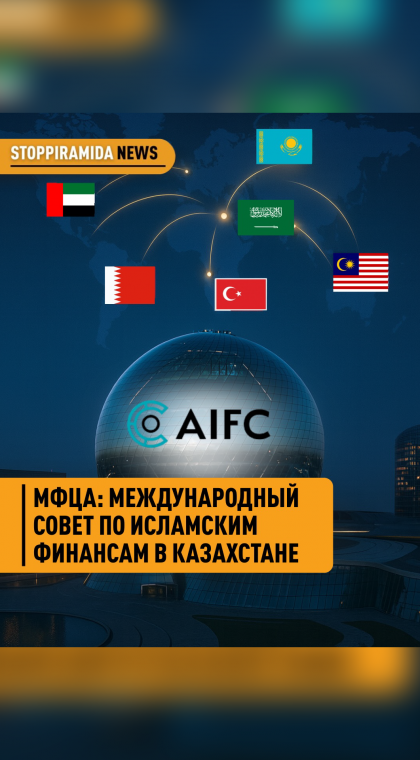
Fake Halal
Fake investment schemes disguised as religious initiatives.
Social media ads promoting “halal investments” promise easy money and large returns. Users are directed to Telegram, where fraudsters pose as experts, use religious themes to gain trust, and offer various “money-making” schemes.
These include promises of earning 300,000–500,000 tenge after investing just 5,000–20,000 tenge, sports betting, and supposedly “winning” casino algorithms. After the first transfer, victims may be asked to make additional payments disguised as taxes and fees.
Do not trust promises of guaranteed or quick returns. Check the project and the recipient of the payment before transferring any money.
On Stop-Piramida.kz, you can check projects showing signs of financial pyramid schemes and fraud.

Investment channels are circulating on Telegram that use religious themes and promise high returns within just a few hours. To gain trust, they refer to Quranic verses and hadiths, claim to offer “halal investments,” show numerous video testimonials, and promise to multiply investments many times over.
At the same time, users are pressured to transfer money quickly, with payments being sent not to a company account but to the bank cards of private individuals.
Do not trust religious imagery or promises of guaranteed returns. Check the documents, the payment recipient, and information about the project before transferring any money.
On Stop-Piramida.kz, you can check a project against our database of projects showing signs of financial pyramid schemes and fraud, or contact our call center for a consultation.
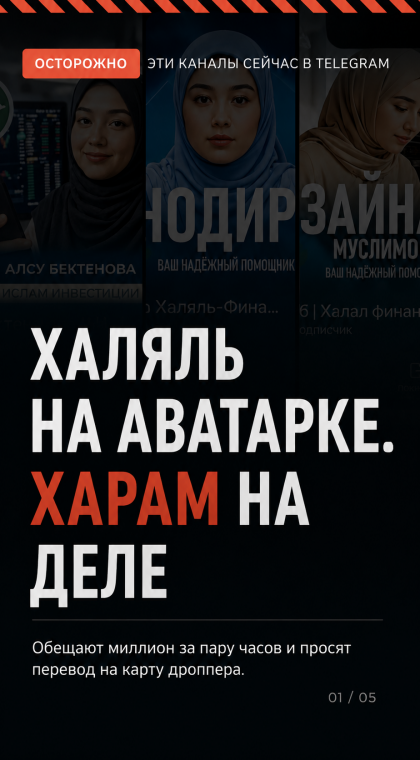
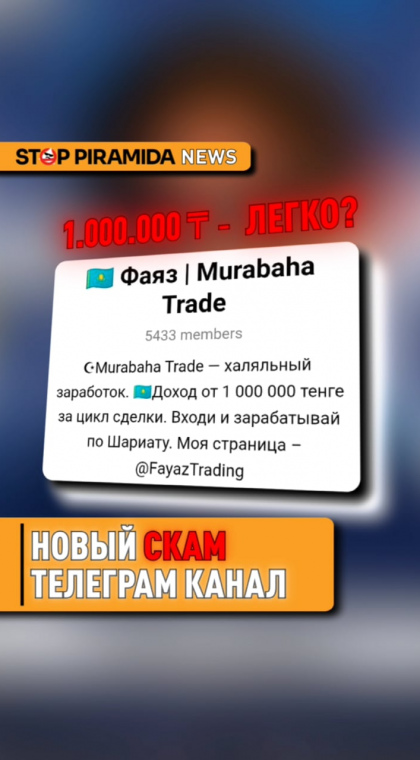
Telegram channels “Zainab | Halal Finance” and “Zainab Muslimova” promote “halal investment” opportunities involving an allegedly official trader of the Murabaha Trade Sharia-compliant exchange. Users are promised up to 1 million KZT in just a few hours. In this video, we examine the warning signs that may indicate fraud.

Telegram is being used to promote “halal investment” opportunities with promises of earning from 850,000 KZT. In this video, we examine the warning signs that may indicate fraud.

Telegram is being used to promote “halal earnings” and “halal trading” opportunities with promises of high returns within just a few hours. To build credibility, claims of Sharia compliance, certificates, and other materials creating the appearance of legitimacy are used. In this video, we examine the warning signs that may indicate fraud.
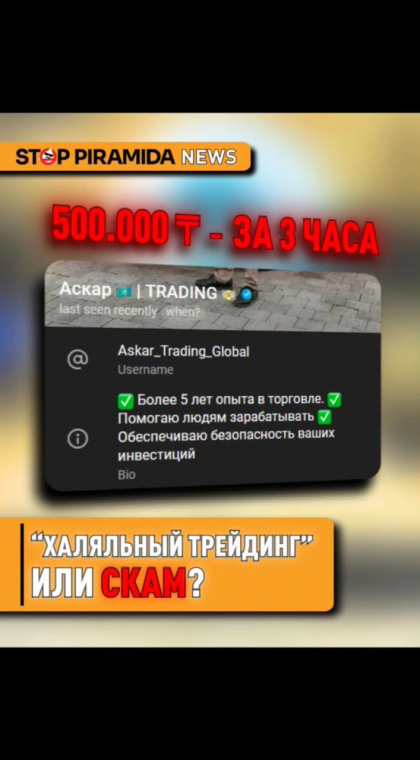
Telegram channels “Fayaz | Murabaha Trade” and “Timur | Murabaha Trade” promote “halal earnings” through the Murabaha Trade platform. Users are asked to invest from 18,000 KZT and are promised returns starting from 800,000 KZT in just 3 hours, along with claims of a 100% money-back guarantee. In this video, we examine the warning signs that may indicate fraud.
Telegram is being used to promote "halal investments" with promises of quick, guaranteed, risk-free returns. In this video, we explain how this scheme works.
_420x760_78c.jpg)
Telegram is being used to promote cross-currency crypto arbitrage as an earning opportunity. To build credibility, an identity document, a license, and other materials creating the appearance of legitimacy are used. In this video, we examine the warning signs that may indicate fraud.

The Spiritual Administration of Muslims of Kazakhstan (SAMK) has announced new initiatives related to the development of Islamic finance and the launch of an AI imam.
According to the announcement, a specialized Islamic finance division will be created, along with a digital assistant designed to answer religious questions and help users with everyday Islamic inquiries.

The Astana International Financial Centre (AIFC) has announced the creation of an International Advisory Council on Islamic Finance.
The council includes experts from leading Islamic finance jurisdictions. Its role is to provide recommendations on legislation, Sharia governance, capital markets, sustainable finance, digital solutions, and international cooperation.
The initiative is presented as a step toward developing Islamic finance and improving financial literacy in Kazakhstan.