
Money mules
A tool for laundering criminal proceeds from online fraud and drug trafficking through third-party bank accounts.
Promising easy money for just 2–3 hours of work a day? Such job offers may actually be hiding a scheme to recruit money mules. Let’s break down how it works and what consequences it can have.
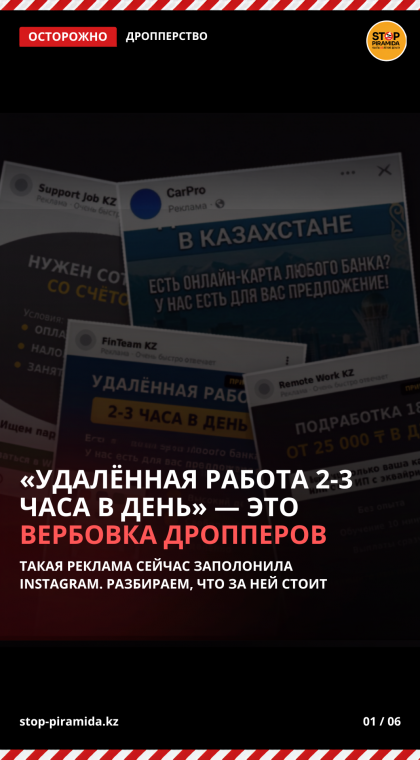
A warning to everyone looking for remote work!
If the job involves receiving and transferring money through your bank accounts or cards, there is a very high risk of becoming involved in criminal activity.
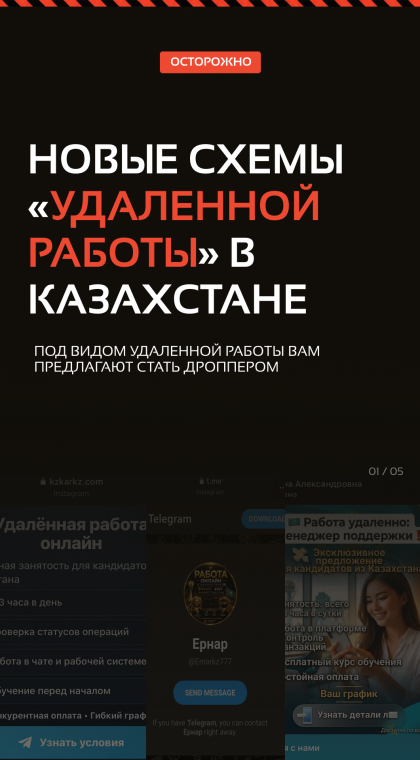
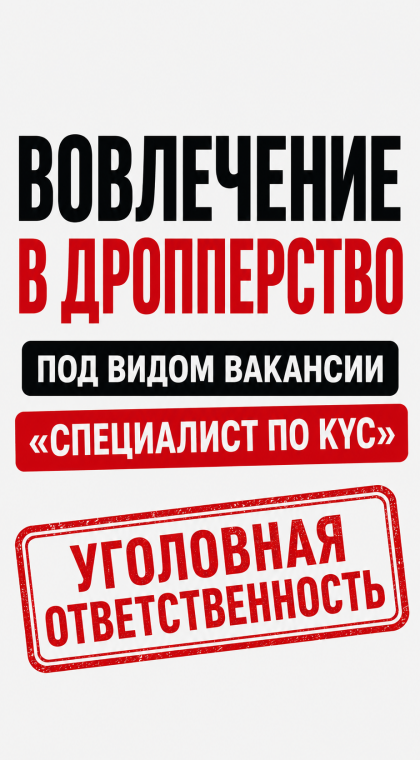
Fraudsters continue to look for new ways to involve people in money mule schemes. Potential participants are now being offered a fake “KYC specialist” vacancy and promised payment for completing identity verification on various online services.
However, instead of the promised income, such “work” may result in involvement in an illegal scheme and criminal liability.
Think critically and learn to identify scam traps together with Stop-Piramida.kz.
Advertisements promising "easy money" are spreading on social media, offering income for every transfer and inviting people to use their bank accounts for financial transactions.
In reality, such offers are often attempts to recruit money mules — people whose bank accounts are used to conduct illegal transactions on behalf of others.
Participation in such schemes may result in criminal liability.

Starting January 1, 2026, banks in Kazakhstan will be required to retain ATM video recordings for at least 180 days. If a transaction is later deemed suspicious, the individuals involved may be identified retrospectively.
The measure is linked to the growing volume of cash withdrawals through questionable schemes. According to the Financial Monitoring Agency, 13.3 trillion tenge has been withdrawn through ATMs in recent years.
The enhanced controls are intended to reduce the use of money mule accounts and make it more difficult to cash out funds obtained through criminal activities.
At the same time, ordinary ATM transactions by themselves are not grounds for a tax audit.

On social media, users are being offered an "easy way to earn money" — selling an Alatau City bank card for 60,000 tenge.
In private messages, scammers encourage people to hand over their cards, claiming they will be used for supposedly "legal P2P transactions" and promising payments for their use.
In reality, they are trying to recruit money mules — individuals who provide their bank cards to third parties for financial transactions.
Such actions may result in criminal liability, including up to seven years of imprisonment.

Professional money mules who provide services to scammers in exchange for financial rewards already operate in Kazakhstan. This was stated by Yuriy Lee, head of the Stop-piramida.kz project, in an interview with BES.media.

Scammers intimidate money mules and extort money by posing as law enforcement officers.
What should you do if you find yourself in this situation?
_420x760_78c.jpg)
What should you do if you become a money mule, and who can be prosecuted under the law on money muling?
_420x760_78c.jpg)
Starting from September 16, Kazakhstan will introduce criminal liability for the first time for money mules — individuals who transfer or sell their bank cards for laundering stolen funds. From August 31, the import and use of SIM boxes will also be prohibited, except for licensed telecommunications operators. These measures are part of the law adopted on June 30, 2025, aimed at strengthening the protection of consumers of financial services and combating phone and online fraud.
Law enforcement agencies are already reporting results. In Aktobe, a 26-year-old man was detained on suspicion of defrauding elderly people. In Bishkek, a joint operation involving Kazakhstan, Kyrgyzstan and Russia dismantled a cybercrime channel, seizing a 32-slot SIM box, dozens of SIM cards and equipment used to spoof calls.
The Ministry of Internal Affairs emphasizes that the new legislation targets key tools used by fraudsters, including money mules and SIM boxes. The era of impunity for accomplices is coming to an end.
How to avoid becoming a money mule:
• Never hand over your bank card or banking details to third parties.
• Do not agree to “easy jobs” involving money transfers or cash withdrawals.
⚠️ Stop Piramida warns: even if you did not realize you were helping scammers, such actions may still result in criminal liability.